Welcome

Welcome to my blog. The contents of my Blog, it is about weapons

Selasa, 16 Agustus 2011

AI L115A1

G22 ohne Schalldaempfer.jpg
The AWM (Arctic Warfare Magnum) is a sniper rifle manufactured by Accuracy International. It is also known as the AWSM (Arctic Warfare Super Magnum), which typically denotes the .338 Lapua Magnum version.

The AWM rifle is a variant of the British Accuracy International Arctic Warfare (AW). Compared to the AW, the AWM has a longer bolt to accommodate larger magnum-length cartridges such as the .300 Norma Magnum and the .338 Lapua Magnum.
The AWM features a detachable box magazine which holds five rounds. The normal cartridges for this rifle, and the ones which have been accepted by NATO for use in AWM rifles, are .300 Winchester Magnum and .338 Lapua Magnum.
Muzzle brakes are fitted to reduce recoil, jump and flash and act as a base for optional iron sights and suppressors.
Normally, the AWMs are outfitted with a Schmidt & Bender PM II 10x42/MILITARY MK II 10x42 telescopic sight with 10x fixed power of magnification. However, a Schmidt & Bender PM II/MILITARY MK II with variable magnification of either 3-12x50, 4-16x50 or 5-25x56 can be used if the operator wants more flexibility to shoot at varying ranges, or when a wide field of view is required. Accuracy International actively promotes fitting the German made Schmidt & Bender PM II/MILITARY MK II product line as sighting components on their rifles, which is rare for a rifle manufacturer. The German and Russian Army preferred a telescopic sight made by Zeiss[1] over Accuracy International's preference.
The AWM rifle is normally supplied in a metal transit case together with scope, mount, butt spacers, bipod, spare magazines, sling, cleaning and tool kits.
(Sources from Wikipedia)

Selasa, 09 Agustus 2011

History of Accuracy International

Accuracy International.svg
Accuracy International is a specialist British firearms manufacturer based in Portsmouth,HampshireEngland and best known for producing the Accuracy International Arctic Warfareseries of precision sniper rifles. The company was established in 1978 by British Olympicshooting gold medallist Malcolm CooperMBE (1947–2001), Sarah Cooper, Martin Kay, and the designers of the weapons, Dave Walls and Dave Caig. All were highly skilled international or national target shooters. Accuracy International's high-accuracy sniper rifles are in use with many military units and police departments around the world.
Accuracy International went into liquidation in 2005, and was bought by a British consortium which has resulted in the original design team now being back in control of the company.
The company is currently (2009) equally owned by two directors, Dave Walls and Tom Irwin along with Paul Bagshaw. Dave Caig remains in the business as a consultant.[1]
The Accuracy International rifle system has gained success, due in part to the design considerations put into the overall rifle. The rifles are hand-built. The AWSM (Arctic Warfare Super Magnum) set the record for the longest confirmed combat kill.
The rifle stock design is designed for good ergonomics. The comfort in holding the rifle and the reduced recoil aids accuracy.
The barrel is interchangeable with other calibres; this can be done in the field in about 15 minutes. With the barrel clamped in a barrel vice, the barrel is removed from the action, and another one screwed into the action and tightened in place with a torque wrench.
The inherent accuracy of the rifle is due to the action being bolted with four screws and permanently bonded with epoxy material to an aluminium frame to which all major rifle components are attached. As it keeps the action from moving away from zero, the accuracy of the rifle is very high. Adding a folding stock handle, this sniper rifle can be used for both HALOinsertions and walking deployments of sniper forces.
Accuracy International introduced their new AS50 .50 BMG calibre semi-automatic rifle at the 2005 SHOT Show in Las Vegas.
The UK government announced in March 2008 the award of an £11 million contract to produce rifles for the British Army.[2]
(Sources from Wikipedia)

AUG A1 A2 A3

1.AUG A1                                       2.AUG A2                                       3.AUG A3

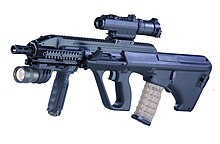
The AUG is an Austrian bullpup 5.56mm assault rifle, designed in the early 1970s bySteyr Mannlicher GmbH & Co KG (formerly Steyr-Daimler-Puch). The AUG (Armee Universal Gewehr—"universal army rifle") was adopted by the Austrian Army as theStG 77 (Sturmgewehr 77) in 1977,[3] where it replaced the 7.62mm StG 58 automatic rifle (a license-built FN FAL).[4] In production since 1978, it is the standard small arm of the Austrian Bundesheer and various national police units.
The rifle has also been adopted by the armed forces of ArgentinaAustralia ( - accepted into service in 1985 and manufactured by Australian Defence Industries inLithgow, the F88 Austeyr model is also in use by New Zealand), BoliviaEcuador(since 1988), Republic of IrelandLuxembourgSaudi ArabiaTunisia (introduced in 1978), Pakistan, and (since 1988) U.S. Customs Service (now the U.S. Immigration and Customs Enforcement agency).

The AUG, a bullpup 5.56mm assault rifle, is a selective fire weapon with a conventional gas piston operated action that fires from a closed bolt.[5] Designed as a family of rifles that could be quickly adapted to a wide variety of roles with the change of the barrel to a desired length and profile, the AUG is a modular configuration rifle that employs a high level of polymer and advanced alloy components.
The primary variant of the rifle, designated the AUG A1, consists of six main assemblies: the barrelreceiver with integrated telescopic sight, bolt and carrier,trigger mechanism, stock and magazine.[5]
The AUG uses the 5.56x45mm NATO cartridge and the standard 1:9 rifling twist will stabilize both SS109/M855 and M193 bullets. Some nations including Australia andNew Zealand use a version with a 1:7 twist optimised for the SS109 NATO round.
(Sources from Wikipedia)


Izhmash AK-47

Rifle AK-47.jpg
The AK-47 is a selective-firegas-operated 7.62×39mm assault rifle, first developed in the Soviet Union by Mikhail Kalashnikov. It is officially known as Avtomat Kalashnikova(Автомат Калашникова). It is also known as a Kalashnikov, an "AK", or, in Russianslang, Kalash.
Design work on the AK-47 began in the last year of World War II (1945). After the war in 1946, the AK-46 was presented for official military trials. In 1947 the fixed-stock version was introduced into service with select units of the Soviet Army. An early development of the design was the AKS-47 (S—Skladnoy or "folding"), which was equipped with an underfolding metal shoulder stock. In 1949, the AK-47 was officially accepted by the Soviet Armed Forces and used by the majority of the member states of the Warsaw Pact.
The original AK-47 was one of the first true "assault rifles" to be manufactured, after the original Sturmgewehr 44.[5][6] Even after six decades the model and its variants remain the most widely used and popular assault rifles in the world because of their durability, low production cost, and ease of use. It has been manufactured in many countries and has seen service with armed forces as well as revolutionary and terrorist organizations worldwide. The AK-47 was the basis for developing many other types of individual and crew-served firearms. More AK-type rifles have been produced than all other assault rifles combined.[2]
Firing the 7.62x39mm cartridge, the AK-47 produces significant wounding effects when the projectile tumbles and fragments in tissue;[7] but it produces relatively minor wounds when the projectile exits the body before beginning to yaw.[8][9]

During World War II, the Germans first pioneered the assault rifle concept, based upon research that showed that most firefights happen at close range, within approximately 300 meters.[citation needed] The power and range of contemporary rifle cartridges was excessive for most small arms firefights. As a result, armies sought a cartridge and rifle combining submachine gun features (large-capacity magazine, selective-fire) with an intermediate-power cartridge effective to 300 meters. To reduce manufacturing costs, the 7.92x57mm Mauser cartridge case was shortened, the result of which was the lighter 7.92x33mm Kurz.
The resultant rifle was the Sturmgewehr 44 (StG44). An earlier firearm, the Italian Cei-Rigotti combined similar features but suffered poor reliability and ejection mechanism, as well as inferior magazine capacity. Towards the end of the war, the Germans fielded the StG44 against the Soviets; the experience deeply influenced Soviet military doctrine in the post-war years.[citation needed]
Mikhail Kalashnikov began his career as a weapon designer while in a hospital after he was shot in the shoulder during the Battle of Bryansk.[10]After tinkering with a sub-machine gun design, he entered a competition for a new weapon that would chamber the 7.62x41mm cartridge developed by Elisarov and Semin in 1943 (the 7.62x41mm cartridge predated the current 7.62x39mm M1943). A particular requirement of the competition was the reliability of the firearm in the muddy, wet, and frozen conditions of the Soviet front line. Kalashnikov designed a carbine, strongly influenced by the American M1 Garand, that lost out to the Simonov design that later became the SKS semi-automatic carbine. At the same time, the Soviet Army was interested in developing a true assault rifle employing a shortened M1943 round. The first such weapon was presented by Sudayev in 1944, but trials found it to be too heavy.[11] A new design competition was held two years later where Kalashnikov and his design team submitted an entry. It was a gas-operated rifle which had a breech-block mechanism similar to his 1944 carbine, and a curved 30-round magazine.
Kalashnikov's rifles (codenamed AK-1 and −2) proved to be reliable and the weapon was accepted to second round of competition along with designs by A.A Demetev and F. Bulkin. In late 1946, as the rifles were being tested, one of Kalashnikov's assistants, Aleksandr Zaytsev, suggested a major redesign of AK-1, particularly to improve reliability. At first, Kalashnikov was reluctant, given that their rifle had already fared better than its competitors. Eventually, however, Zaytsev managed to persuade Kalashnikov. The new rifle was produced for a second round of firing tests and field trials. There, Kalashnikov assault rifle model 1947 proved to be simple and reliable under a wide range of conditions with convenient handling characteristics. In 1949 it was therefore adopted by the Soviet Army as '7.62mm Kalashnikov assault rifle (AK)'.[12]
(Sources from Wikipedia)

Izhmash Dragunov SVD

Svd 1 russian.jpg
The Dragunov sniper rifle (formally RussianСнайперская винтовка Драгунова,Snayperskaya Vintovka Dragunova (SVD), literally "Dragunov's sniper rifle") is a semi-automatic sniper rifle/designated marksman rifle chambered in 7.62x54mmR and developed in the Soviet Union.
The Dragunov was designed as a squad support weapon, since according to Soviet and Soviet-derived military doctrines the long-range engagement ability was lost to ordinary troops when submachine guns and assault rifles (which are optimized for close-range and medium-range, rapid-fire combat) were adopted.
It was selected as the winner of a contest that included three competing designs: the first was a rifle designed by Sergei Simonov (known as the SSV-58), the second design, a prototype designated 2B-W10 by Alexander Konstantinov, and the third rifle, the SVD-137, a design submitted by Yevgeny Dragunov. Extensive field testing of the rifles conducted in a wide range of environmental conditions resulted in Dragunov’s proposal being accepted into service in 1963. An initial pre-production batch consisting of 200 rifles was assembled for evaluation purposes, and from 1964 serial production was carried out by Izhmash.
Since then, the Dragunov has become the standard squad support weapon of several countries, including those of the former Warsaw Pact. Licensed production of the rifle was established in China (Type 79 and Type 85) and Iran (as a direct copy of the Chinese Type 79).
The Dragunov is a semi-automatic gas-operated rifle with a short-stroke gas-piston system. The barrel breech is locked through a rotating bolt (left rotation) and uses three locking lugs to engage corresponding locking recesses in the barrel extension. The rifle has a manual, two-position gas regulator.
After discharging the last cartridge from the magazine, the bolt carrier and bolt are held back on a bolt catch that is released by pulling the cocking handle to the rear. The rifle has a hammer-type striking mechanism and a manual lever safety selector. The rifle's receiver is machined to provide additional accuracy and torsional strength. The Dragunov's receiver bears a number of similarities to the AK action, such as the large dust cover, iron sights and lever safety selector, but these similarities are primarily cosmetic in nature.


MR Inc. Desert Eagle

The Desert Eagle is a large-framed gas-operated semi-automatic pistol designed byMagnum Research in the U.S. and by IMI in Israel; the pistol is manufactured primarily in Israel by IMI (Israel Military Industries, now Israel Weapon Industries). Manufacturing was moved to Saco Defense in the state of Maine from 1996 to 2000 which carried the XIX designation, but shifted back to Israel when Saco was acquired by General Dynamics.[2] The Desert Eagle has been featured in roughly 500 motion pictures and TV films, considerably increasing its popularity and boosting sales.[3]
Magnum Research has marketed various versions of the short recoil Jericho 941 pistol under the Baby Eagle name; these have no functional relationship to the Desert Eagle and bear only a moderate cosmetic resemblance.[4]

The Desert Eagle was originally designed by Bernard C. White of Magnum Research, who filed a US patent application for a mechanism for a gas-actuated pistol in January 1983.[5] This established the basic layout of the Desert Eagle. The Desert Eagle was originally designed as a revolver, but was later reshaped into a semi-automatic pistol. A second patent application was filed in December 1985, after the basic design had been refined by IMI for production, and this is the form that went into production.[2]
The Desert Eagle uses a gas-operated mechanism normally found in rifles, as opposed to the short recoil or blow-back designs most commonly seen in semi-automatic pistols. Unlike most such pistols, the barrel does not move during firing. When a round is fired, gases are ported out through a small hole in the barrel near the breech. These travel forward through a small tube under the barrel, to a cylinder near the front of the barrel. The separate bolt carrier/slide has a small piston on the front that fits into this cylinder; when the gases reach the cylinder they push the piston rearward. The bolt carrier rides rearward on two rails on either side of the barrel, operating the mechanism. Its rotating bolt strongly resembles that of the M16 series of rifles, while the fixed gas cylinder/moving piston resemble those of the Ruger Mini-14 carbine (the original patent used a captive piston similar to the M14 rifle).[4][6] The advantage of the gas-operation is that it allows the use of far more powerful cartridgesthan traditional semi-automatic pistol designs. Thus it allows the Desert Eagle to compete in an area that had previously been dominated by magnum revolvers. Downsides of the gas operated mechanism are the large size of the Desert Eagle, and the fact that it discourages the use of unjacketed lead bullets, as lead particles sheared off during firing could clog the gas release tap, preventing proper function.[4]
Switching a Desert Eagle to another chambering requires only that the correct barrel,bolt assembly, and magazine be installed. Thus, a conversion to fire the other cartridges can be quickly accomplished. The most popular barrel length is 6 in (152 mm), although a 10 in (254 mm) barrel is available. The Mark XIX barrels are machined with integral scope mounting bases, simplifying the process of adding a pistol scope. The rim diameter of the .50 AE is the same as the .44 Remington Magnum cartridge, consequently only a barrel and magazine change is required to convert a .44 Desert Eagle to the larger, more powerful .50 AE.[4][6]
The Desert Eagle is fed with a detachable magazine. Magazine capacity is 9 rounds in .357 Magnum, 8 rounds in .44 Magnum, and 7 rounds in .50 AE. The Desert Eagle's barrel features polygonal rifling. The pistol is primarily used for huntingtarget shooting, and silhouette shooting.[4][6]
(Sources from Wikipedia)